Equity is the most expensive money a founder will ever take, and in the earliest stage it is usually unnecessary. Malaysia, like several Commonwealth markets, runs a deep non-dilutive system — the same instinct that built its grant and training infrastructure. The catch is that it is fragmented across agencies, sequenced in a specific order, and full of small rules that disqualify the unprepared. This is the map.
1. The status that has to come first — Malaysia Digital (MD) Status
MD Status is not cash. It is a certification from MDEC that does two things: it zero-rates tax on qualifying intellectual-property income (for up to ten years on approved activity), and it is the key that unlocks every larger MDEC grant. The application fee is RM 1,080. Eligibility runs to a small paid-up capital, at least two full-time employees in the approved activity, and annual operating expenditure of at least RM 50,000.
Do it first, and specifically before your first revenue invoice, because the tax treatment is far cleaner to claim from day one than to retrofit. Everything in section 3 depends on holding it.
2. The Cradle grants — CIP Spark, then CIP Sprint
Cradle Fund (under MOSTI) runs the two grants that matter most early, and they are designed to be done in order.
| Grant | Amount | For | Key eligibility |
|---|---|---|---|
| CIP Spark | Up to RM 150,000 (18 months) | Pre-commercialisation — build the thing | Company under 5 years; accumulated revenue under RM 3M; team of 2+ (1 Malaysian); holds the IP |
| CIP Sprint | Up to RM 600,000 | Commercialisation — take it to market | Company under 7 years; revenue under RM 5M; 51%+ Malaysian-owned; 2+ directors; RM 10,000 paid-up |
Two honest cautions. First, these are conditional: if the funded project is terminated, the money is repayable — this is not a gift, it is a grant with obligations. Second, CIP Sprint is a conditional convertible grant — Cradle may convert it to equity at a future round. So the cleanest "non-dilutive" line is Spark; Sprint is non-dilutive unless you raise, at which point read the conversion terms as carefully as you would a term sheet.
The single most common own-goal: pitching a portfolio. Cradle evaluates one product per application. A founder with five ideas who pitches five ideas reads as someone with none. Pick the sharpest one and pitch only that.
3. The MDEC grants — bigger, but a Year-2 move
Once you hold MD Status and have roughly a year of operations, the larger grants open up. They are gated, so they are not a day-one plan — they are what the first year buys you access to.
- MDAG-AI (Malaysia Digital Acceleration Grant, AI): up to RM 2 million, typically reimbursing a share of approved project costs.
- MDCG (Digital Content Grant): up to RM 1 million — and notably, IP-protection costs can be claimable, which matters if you are building curriculum or assessment IP.
Both generally require MD Status, at least a year incorporated, and paid-up capital around RM 50,000. Intake windows move; check the current cycle rather than assuming one is open.
4. Cloud credits — six figures you don't repay
Infrastructure is one of the few real costs of an EdTech product, and the cloud providers will largely cover it early.
- AWS Activate: packages up to US$200,000, with a generative-AI tier up to US$300,000 for qualifying AI startups.
- Google for Startups Cloud Program: up to US$200,000 over two years on the standard tier, and up to US$350,000 for AI-first startups.
These are non-cash and you cannot pay salaries with them, but for an AI-assisted product they remove the compute bill that would otherwise eat a grant. Apply early; they are simple relative to the grants.
5. The one most founders miss — the demand side (HRD Corp)
This is the piece that is specific to education and training, and it is the most overlooked.
Malaysian employers with ten or more local staff pay a 1% levy on wages to HRD Corp (those with five to nine can join voluntarily at 0.5%). That levy sits in an account they can only spend on approved training — and most of them don't. By HRD Corp's own 2025 reporting, only about 47% of registered employers made even one claim in the year. Unused balances roll forward, so there is a large, growing pool of money earmarked for training that nobody is using.
For a founder, that reframes the whole B2B motion. If your product is training — AI fluency, upskilling, corporate education — you are not asking a buyer to spend new money. You are helping them use a budget they have already paid and will otherwise forfeit. Register as an HRD Corp training provider, and the SBL-Khas scheme lets HRD Corp pay you, the provider, directly. The demand-side levy turns "please buy this" into "let me help you claim what's already yours."
The stack, in order
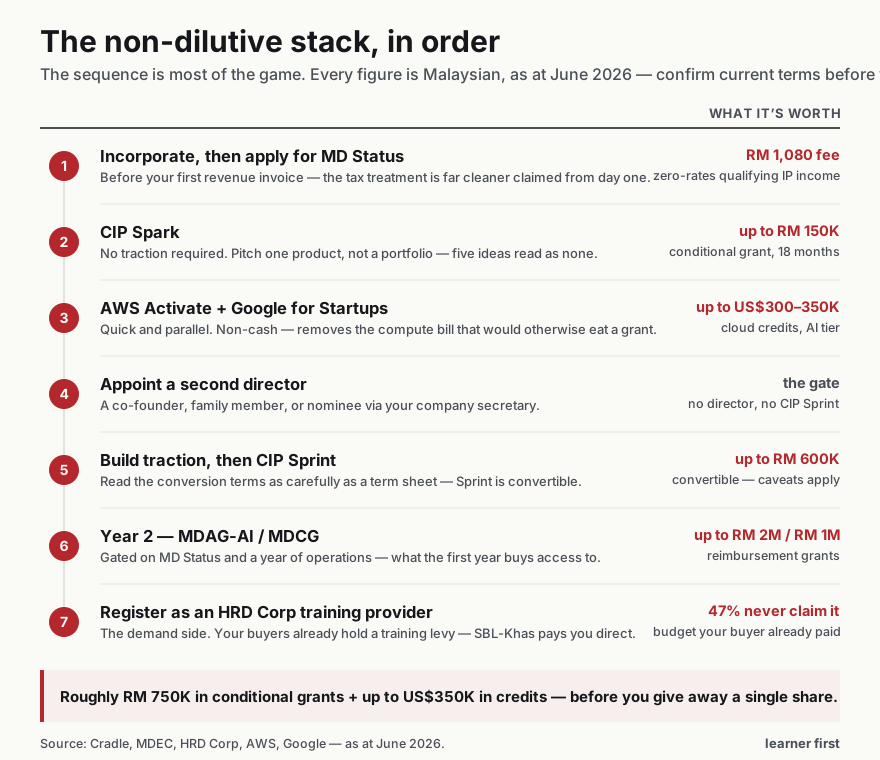
Figure description
The stack in order: (1) Incorporate, then apply for MD Status before your first revenue invoice — RM 1,080 fee, zero-rates qualifying IP income. (2) CIP Spark, up to RM 150K, no traction required, one product per application. (3) AWS Activate and Google for Startups cloud credits, up to US$300–350K, quick and parallel, non-cash. (4) Appoint a second director — the gate for CIP Sprint. (5) Build traction, then CIP Sprint, up to RM 600K, but convertible so read the terms. (6) In Year 2, with MD Status and a year of operations, MDAG-AI and MDCG, up to RM 2M and RM 1M. (7) Register as an HRD Corp training provider — about 47% of employers never claim the levy your buyers already pay. Total envelope: roughly RM 750K in conditional grants plus up to US$350K in credits before giving away a single share.
-
Incorporate, then apply for MD Status — before your first revenue invoice.
-
Apply for CIP Spark (RM 150K) — no traction required; pick one product.
-
Apply for AWS Activate and Google for Startups credits — quick, parallel, non-cash.
-
Appoint a second director (a co-founder, family member, or nominee via your company secretary) — this is the gate for CIP Sprint.
-
Build traction, then apply for CIP Sprint (RM 600K) — read the conversion terms.
-
In Year 2, with MD Status and a year of operations, pursue MDAG-AI / MDCG.
-
If you sell to employers, register as an HRD Corp training provider and build the SBL-Khas motion in.
The traps, collected
- Skipping MD Status, or applying after first revenue. Retrofitting the tax treatment is painful; the grant access is gated on it.
- Pitching a portfolio to Cradle. One product per application, always.
- Treating CIP Sprint as free. It is conditional and convertible — non-dilutive only until you raise.
- Forgetting the second director. No second director, no CIP Sprint.
- Ignoring the demand side. If you sell training and never touch HRDF, you are competing on price against a budget your customer is sitting on.
Frequently asked questions
Can I really fund a startup in Malaysia without giving up equity? Largely, yes, in the earliest stage — CIP Spark plus cloud credits can fund a first product with zero dilution. The larger sums (CIP Sprint, MDEC grants) carry conditions, and Sprint can convert to equity, so "non-dilutive" has caveats worth reading.
What's the single highest-leverage first step? MD Status, applied for before your first revenue invoice. It zero-rates qualifying IP income and unlocks the larger grants.
Why does HRDF matter for an EdTech founder specifically? Because if your product is training, your buyers already hold a levy fund earmarked for exactly that — and most of it goes unspent. You sell into existing budget, not new spend.
A note on why we wrote this. Non-dilutive capital is badly under-used by EdTech founders in this region, and the map is scattered across a dozen agencies and schemes. We pulled it into one place — the map we'd want a founder to have. We don't run a fund and we don't take a cut of your grants. How we work: editorial standards.
Sources
- Cradle Fund — CIP Spark: https://www.cradle.com.my/cip-spark/
- Cradle Fund — CIP Sprint: https://www.cradle.com.my/cip-sprint/
- MDEC — Malaysia Digital (MD) Status: https://mdec.my/malaysiadigital
- HRD Corp — SBL-Khas claimable training scheme: https://hrdcorp.gov.my/
- AWS Activate credits for startups: https://aws.amazon.com/startups/credits/
- Google for Startups Cloud Program: https://cloud.google.com/startup