How we review tools
Every tool we review is put through the same two questions, in the same order: does it fit the students it’s sold to, and is it any good. We report those two things separately, because they’re not the same thing — and most reviews quietly fold one into the other.
This page is the rubric, written down. It’s the same for every tool, including ones we like and ones we don’t.
Fit: the Four Mismatches Test
Fit is four questions, asked for one country at a time. A tool is system-native for a country only when it clears all four there. Fit is never one verdict for the whole world: the same tool can fit a student in India and miss for a student in Kenya, so every tool page lets you check it for your own country. The full diagnostic, with worked examples, is in The Four Mismatches Test.
1. Curriculum
Does it teach the exam your students actually sit — SPM/KSSM, Cambridge IGCSE — or someone else's, like US Common Core?
2. Language
Does it work in the languages of the classroom — for a Malaysian room, Bahasa Melayu and English side by side — or English only?
3. Price
Can an ordinary family afford it without thinking about it — streaming-subscription money — or is it priced for a different economy? This is the one axis AI has already fixed.
4. Device
Does it run on a phone, on a patchy connection, without assuming always-on broadband and a personal laptop?
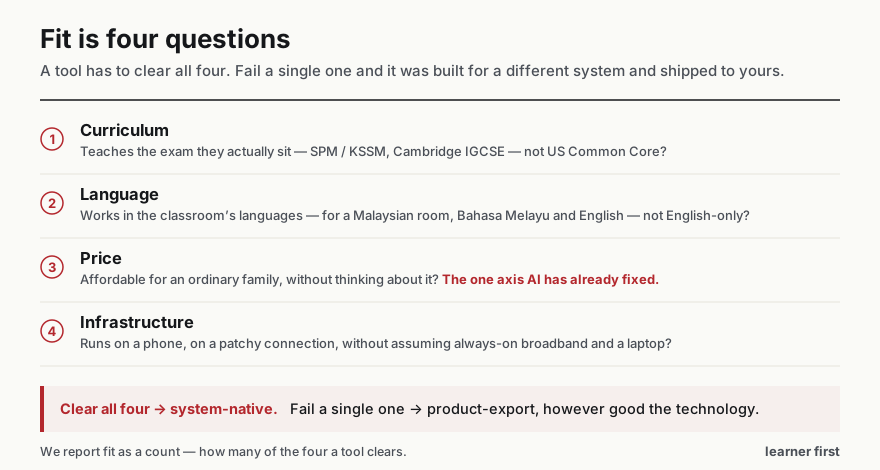
Figure description
Fit is four questions and a tool must clear all four. Curriculum: does it teach the exam they actually sit (SPM/KSSM, Cambridge IGCSE) rather than US Common Core? Language: does it work in the classroom's languages (Bahasa Melayu and English) rather than English-only? Price: is it affordable for an ordinary family — the one axis AI has already fixed? Device: does it run on a phone, on a patchy connection, without assuming always-on broadband? Clear all four and it is system-native; fail a single one and it is product-export, however good the technology.
How each fit verdict is worked out
Nobody hand-scores fit. Each verdict comes from a fixed rule applied to what the tool’s maker publishes about it: its own website, help pages, terms and app-store listings. Every verdict on a tool page shows the facts it used, with links to where we found them.
- Curriculum
- Fits if the maker names an exam students in that country sit. Doesn't fit if it names other school exams but none of those. A tool that names no school exam counts neither way; adult or professional exams such as TOEIC don't count as school exams.
- Language
- Fits if it teaches in every main classroom language of that country, partly if in some, and doesn't fit if in none.
- Price
- Fits if there is a free plan, or the cheapest paid plan costs no more than a basic streaming plan in that country (we use the cheapest plan of a major streaming service, taken from its own price page). Partly fits up to twice that, and doesn't fit above it. Prices in other currencies are converted at a dated official exchange rate. Tools only schools can buy are marked as such.
- Device
- Fits if the maker says it works on the device most students in that country use. That device comes from the share of homes with a computer, from the ITU (the UN's telecoms agency): under half means a phone, otherwise a laptop or tablet.
- Anything we couldn't find
- Shows as not verified. It never counts as a pass or a fail.
Each verdict shows one of six marks: fits, partly, doesn’t fit, no exam claimed, not verified and bought by schools. The headline on each card names the main mismatch, such as “Built for another system” or “Costs more than the local line”, rather than a score out of four.
Quality: the score out of five
The score is about the tool itself, not its fit: how good the teaching is, how honest the product is about its own limits, how well it’s built and integrated, and whether there’s real evidence it works. A tool earns its number on those terms alone.
Keeping the two apart is the whole point. A tool can clear all four mismatches and still score in the middle because the teaching is thin. Another can be one of the best-built tutors in the world, score near the top, and still fit only one of the four for a Commonwealth buyer. Both are true at once, and a single star rating would hide it. So we give you the score and the fit, and let you weigh them for your own situation.
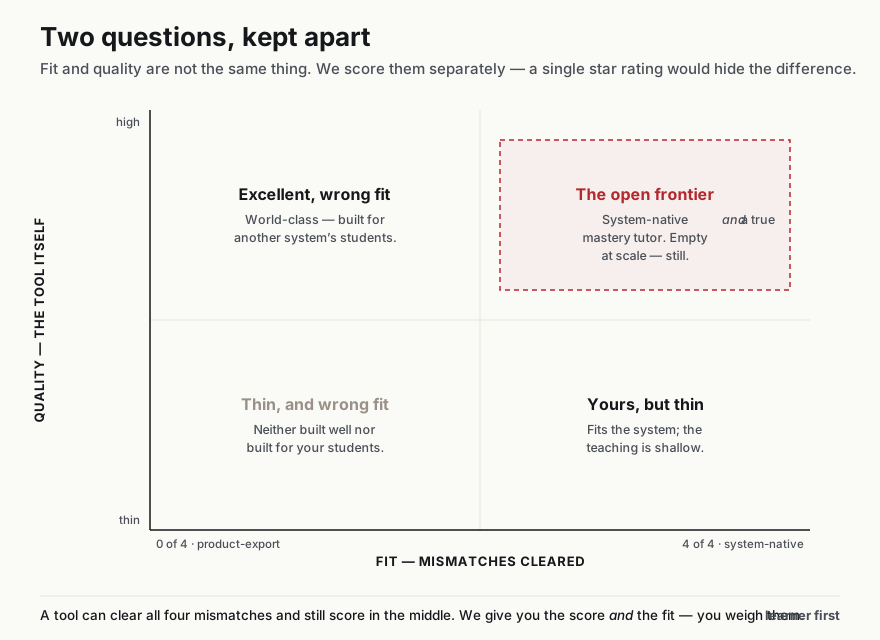
Figure description
We plot two independent axes. Quality (vertical) is how good the tool itself is; fit (horizontal) is how many of the four mismatches it clears. Four quadrants result: excellent-but-wrong-fit (high quality, low fit — a world-class tool built for another system); thin-and-wrong-fit (low on both); yours-but-thin (high fit, low quality — fits the system but the teaching is shallow); and the top-right open frontier — system-native and a true mastery tutor at once — which is still empty at scale. A tool can clear all four mismatches and still score in the middle, so we report the score and the fit separately and let you weigh them.
Independence, and how we make money
- No paid placement, ever. A tool cannot pay to be reviewed, to score higher, or to appear in a list. The rubric above is the only thing that moves a score.
- We exclude our own products, and their competitors. Our publisher builds education software. We don’t score or rank its products, or any tool that competes with them: those are listed with verified facts only, so the judgement is yours.
- We’re plain about commission. Today we earn no commission from any tool we’ve reviewed. If that ever changes, the page will say so, and it still won’t change the score.
The wider standards behind all our writing — who authors it, how claims are checked, and how we handle corrections — are on the editorial standards page.